Welcome

I got the idea for this new blog at the end of the week of New Wine, a Christian festival in Somerset, in August 2011. You might guess from my profile that, although not entirely house-bound, I don't very often get out, and it occurred to me that I might try to create a blog to encourage in our faith people like me whose lives are limited in one way or another. I'm hoping that readers will feel able to contribute their own positive ideas. I'm not sure how it will work, but here goes...!
Teach me, my God and King, in all things Thee to see...
A man that looks on glass,
On it may stay his eye,
Or, if he pleaseth, through it pass
And then the heaven espy.

George Herbert (1593-1633)

Thursday, 25 July 2013

Kate Granger's "Dear Cancer"

I must copy this blog post from Dr Kate Granger, one of the bloggers I most admire, in its moving entirety. As a specialist in elderly medicine, she knows what she's talking about.


Dear Cancer…


Dear Cancer,
It has been an extremely interesting 2 years getting to know you. You gave me quite a shock in America all those months ago. To be honest your appearance in my life at that time was unwanted and frightening. My career was flourishing and we were planning to start a family. You took away all those aspirations in one fail swoop and left me in a mutilated and depressed state. I’m not sure I can ever properly forgive you for that although I immediately accepted that this was how my life was going to be, and that you were to be a constant companion that I was going to have to learn to get along with.
The months of treatment to suppress you and bring you under control took their toll on me both physically and mentally until I decided to stop the treatment and let you do your worst. I was determined to keep smiling and live my life to the full including a return to work before you got the better of me. In some ways it is because of you that I have been able to live the most wonderful lifestyle for the past year. I never would have been able to meet the Queen if it wasn’t for you so in a strange kind of way I am grateful. I think you have made me into a much more tolerant, optimistic and happy person and I thank you for that.   
Well, you’ve been asleep now for 19 months. I wonder every day how to keep you settled and peaceful in your slumber. I also wonder every day when you are going to awaken and how you plan to take my life. Are you going to obstruct my bowels? Are you going to cause a pulmonary embolism? Are you just going to overwhelm my body? I guess you haven’t decided this yet yourself, but please be kind and let it be quick whichever way you finally settle on.
Kind regards, 
Kate x
I do recommend you read her blog (http://drkategranger.wordpress.com/). It combines clear-sighted realism with a positive outlook which is such a contrast to the victimhood "pity-me" approach which all too many people encourage us terminally ill patients to adopt. It is simply beautiful. And inspiring.

Saturday, 20 July 2013

The uses of adversity

Outside the theatre
A week ago, Jane and I drove to Stratford to see the RSC production of As You Like it, to celebrate our wedding anniversary. It was, you'll recall, one of the glorious clear sunny days we've been enjoying. We were very grateful for the air-conditioning in our car!

The production was great fun - once the men had got over mistaking shouting for emphasis and Jaques had stopped gabbling (I must be getting old and hard of hearing!). In my view, it shouldn't be necessary to have mugged up on a Shakespeare play to understand the meaning. Really good actors are able to bring Shakespearean English to life even for contemporary audiences. Fortunately the central characters achieved just that, most importantly Rosalind, the most major female role in Shakespeare (25% of lines), played by Pippa Nixon.
Rosalind and Orlando finally united (the "hippy" Duke just behind Orlando) - RSC photo

The plot involves an usurping duke and a selfish older brother driving various of their relatives into exile in the Forest of Arden (I assume where the paté comes from). In his first speech the ousted Duke, Senior, portrayed in this production presiding over something of a hippy-style commune and himself a bit like an aging rock star, says:
"Here feel we but the penalty of Adam,
The seasons' difference, as the icy fang

And churlish chiding of the winter's wind,
Which, when it bites and blows upon my body,
Even till I shrink with cold, I smile and say
'This is no flattery: these are counsellors
That feelingly persuade me what I am.'
Sweet are the uses of adversity,
Which, like the toad, ugly and venomous,
Wears yet a precious jewel in his head;
And this our life exempt from public haunt
Finds tongues in trees, books in the running brooks,
Sermons in stones and good in every thing.
I would not change it." 


I was struck by the expression, "Sweet are the uses of adversity". Our instinct is to run from adversity, to avoid pain. And yet there is something precious to be found in it. Exiled from all that is "civilised", what we might regard as the normal comforts of life, the Duke finds "good in every thing". This is poetry of course which can't be paraphrased - but, for example, the trees might speak of the beauty in each season of life and the miracle of rebirth, the brooks might be illustrating the infinite diversity and the wonderful interconnectedness of creation, and the stones teach that hardship is an integral part of existence; without it life would be bland.
Rosalind disguised as the young man, Ganymede - RSC photo
Pippa Nixon's performance was outstanding, with the ambiguities and tensions of the role, beginning and ending as the lively Rosalind and in between disguised as Ganymede, at once strong and vulnerable. It's a supremely demanding part. I suppose we were focused on her as she once came to a birthday barbecue in our garden here; so we were pleased to be able to congratulate her at the end. A great way to celebrate our marriage - thanks, Pippa and the RSC!

Wednesday, 10 July 2013

Understanding God

Here's something that Bo Stern has recently written about working on her new book, Ruthless - Knowing the God who fights for you.
"Here's what I'm convinced of, friend:  God longs for us to know Him.  Just like we long to be known and loved by those dearest to us; He longs for us to pursue an understanding of His character.  I'm freshly aware of how painful it must be for Him when we shake our fist at the problems we think He caused or treat Him like a vindictive, volatile taskmaster.  I'm also convinced that this ignorance regarding His ability and integrity (aka: bad theology) is why so many Christians are stuck in bitterness, frustration and purposelessness, especially when they face a Really Big Battle."
And something else, adapted from a book I've just finished reading by Salley Vickers, Miss Garnet's Angel. "What do you think a god looks like when he works in men? ... courage and truth and mercy and right action...", said by the Archangel Raphael to Tobias. 
I apologise not to have blogged recently. I blame our daughter's new therapy puppy - but perhaps it would be fairer to accuse my own lack of resistance to Wimbledon and the Tour de France! And I'm trying also to get on with my own book....

Tuesday, 11 June 2013

Bothering enough

On Sunday I was justly rebuked for an uncompassionate knee-jerk comment I made in reaction to a news story. It is painful but healthy when someone bothers enough to upbraid you - and they're right!

Today is St Barnabas' Day, and I've just read this from the iBenedictines blog. 


Encouragement

by Digitalnun on June 11, 2013
St Barnabas, the Son of Encouragement, gets something of a raw deal from the Church. His feast is kept as a memoria rather than a festum, and his (presumed) mortal remains are kept in a basilica in northern Cyprus* (looked after by a Muslim caretaker) rather than in some grand church in Rome. No doubt it is my quirky sense of humour, but that strikes me as being very fitting for someone who gives encouragement. To encourage another, we have to have a very just (= modest) opinion of ourselves and a very generous (= hopeful) opinion of the other. The liturgical reticence of today’s commemoration reminds us that what attracts society’s notice may not be what attracts God’s, that our human values are not always the same as his. Barnabas was to be eclipsed by his disciple, Paul; and the Church remembers the dispute between them chiefly because Paul won his point; but I have a suspicion that in the court of heaven, Barnabas occupies a very high place from which he continues to encourage us still.
* The basilica in Cyprus is very beautiful, with hundreds of magnificent icons. It is certainly not a ‘second-best’ resting-place; my point is that in Rome St Barnabas is hardly mentioned, unlike the other figures of Apostolic times.

I think if I could have chosen a patron saint, it might well be Barnabas. Sadly I was born exactly two months after his memoria!

Tuesday, 4 June 2013

Long reigning Queen

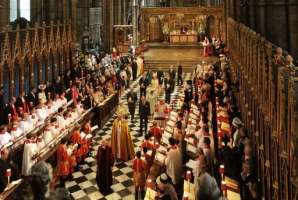
Today saw the service in Westminster Abbey celebrating the 60th anniversary of Queen Elizabeth's reign. I've been struck by the times I have heard her accession to the throne described as a "vocation". I believe that is a good description of how she regards it, not a very popular concept these days.

In my 3 Minute Retreat reading today, based on Isaiah 49.6 ("I will make you a light to the nations...") I read this comment: "Each of is called to be a light to the nations. The light is generated when we are true to our vocations in life. And when each of us acknowledges and develops the talents that are part and parcel of our vocation, the light we bear brings salvation (restoration) to the world. We become co-creators with God in the work of salvation. How do we do this? Through the action of the Holy Spirit. The Spirit is God's life at work in and through us. The more we open ourselves to the movement of the Holy Spirit, the brighter God's light of salvation shines."

"Spirit of God, move through me.
Help me to use my gifts in cooperation with God's plan of salvation."

I like the idea that when St Paul said, "Christ in you, the hope of glory", he was meaning the hope of glory for others. May we be faithful in whatever place and state God has called us.

Thursday, 30 May 2013

Grown-up faith

I am reading a new novel by my friend, Karen Jones, called Sister Acts. It's the second in her "Babe's Bible" trilogy. It might not be to everyone's taste! It's about gritty contemporary issues and aimed for a younger readership than me. But I'm enjoying it. Among other things it does show that Bible is still highly relevant.

This passage really struck me, where a bishop is seeking counsel from his spiritual director, a nun.
"'Teach me how to take these thoughts captive, Sister,' he pleaded.
"'You must take each one to the cross in prayer. You must see yourself come to the cross, bringing each weakness, each longing, each unmet need. See yourself rise up and take your place on the cross with him. Let the nails be driven into your flesh with him. Die with him there, and then be laid in a tomb with him. Then, and only by his leading, rise with him and live by his Spirit the new life he gives you,' her face shone as she spoke."

Taking one's thoughts captive sounds easy. Oh yes, I can control my mind! The reality is much harsher. It's a matter of grim will, assisted by the Holy Spirit.

Saturday, 25 May 2013

Pentecost at Maldon

Someone asked me if I could put up all of my friend, Rob Wiggs' sermon from last Sunday. He's kindly allowed me to do so. So here is what in the trade, I believe, is called a guest post.

Pentecost at Maldon 19th May 2013
As you probably know, I am really interested in envy and rivalry, in inferiority and superiority, and in how we can get these monkeys off our backs and live in freedom and joy. When you are young and worldly you worry about people being more beautiful than you, more popular, more clever and better at sport.  And to get free of these things is really important. They stop us being happy. Ok, but what are the religious forms of inferiority that persist among Christians into later life? People who are bothered by God, and I am deeply in favour of being bothered by God, worry that they haven’t really experienced God, and they look at other people and say, what is it that they have that I haven’t got? Wouldn’t you agree that you only have to look at Father xxx and John xxx and it is just obvious that they are oozing with a knowledge of God that the rest of us don’t understand?

But, of course, this is all rubbish. Let me tell you something that a famous Indian priest, Anthony de Mello, taught. All you have to do to experience God’s Holy Spirit is simply to breathe in. Anthony de Mello spent a huge amount of his life teaching people to breathe in, and hence to receive God’s Holy Spirit. When you have learned how to breathe in you will stop worrying about other people and whether you are beautiful because you will have received God’s Holy Spirit, and nothing else will matter again in the same way. There is nothing living that is not enlivened by God’s Spirit. What must we do to be saved? Breathe.

When I was young in the late 1960s people and early 1970s people used to come up to you and ask you if you were saved. I don’t think they do that now. But it used to worry me. I was never quite sure if I was saved. And then in the late 1970s the question changed. People used to ask you if you had received the Holy Spirit. And I really didn’t think I had received the Holy Spirit. And even after I was ordained I used to worry sometimes that one day people would find out that I wasn’t saved and that I hadn’t received the Holy Spirit. And I used to feel deeply inferior around evangelical and charismatic people. Really religious people scared me, to be quite frank, even after I was a priest. And it was something to do with being made uncomfortable and the fear that they might find out that I am a fraud.

But then I made the most wonderful discovery. I started to breathe. And as I breathed I came to recognise that I am indeed a fraud and a phoney, but I can no more stop God loving me than I can stop breathing. And that made all the difference. In the languages of the Bible, both in Hebrew and Greek, breath, wind and spirit, are all the same word. When Jesus rose from the dead, he breathed on his disciples, who were, like me, frauds and phonies, and he said to them, ‘Receive the Holy Spirit’. And he thus filled them with his spirit, authority. And it was the same at Pentecost. A sound like a violent wind is heard, and the disciples receive the Holy Spirit’ and they became authoritative, free, not inferior to anyone.

I want to spin a fantasy. And the fantasy is that the parish project for 2014 is that as many of us as possible learn to breathe. Let me explain how it would work. You would sign up at the end of December to the following commitment. Simply this. You would promise that for 10 minutes at the beginning and the end of every day you would sit still and pay attention to your breathing. Let me tell you what I think would happen.

First we would discover that it is immensely difficult and  many, perhaps most,  would give up. Then we would discover that many of us would need friends, some kind of community to keep us to it. So we would start to have to do it together sometimes. But let us also suppose that many of us did stick to it. What would happen to us ? Over time there would rise up little sanctuaries of freedom. Think of all the nonsense that swirls around in your brain – all the rubbish that is there simply because you are a member of a noisy non-stop society that is terrified of silence. Think of the accusing voices that you are forced to be in dialogue with. My son, whom I love dearly, and who I believe, loves me, nevertheless admits to me that I exist in his brain as a kind of accusing and disapproving voice whom he can’t appease. Do you have angry conversations in your head with your enemies and your accusers ? Or with the things and people who make you afraid ? Do you lie awake in the night in some unwelcome conversation with the spirit of the future, the spirit of how things might turn out, but which is nevertheless a false and lying voice that is never quite so real during waking hours ?

What I am trying to draw attention to is the fact that our brains are never empty, that they are occupied by some kind of spirit, to use biblical language, and frequently by spirits that are not for our flourishing. So what would happen if we committed ourselves to this silent breathing. Not, absolutely not, instant transformation. But what would be beginning would be some kind of spiritual warfare. The dominance of the spirit of the age would be beginning to be broken by the Holy Spirit.

As I have told you before, the Biblical word Satan literally means ‘the accuser’. And the Biblical word the Paraclete, the Holy Spirit, means the Counsel for the Defence.

It is as if both our brains and the whole world we live in is a kind of court, and there is an accusing voice abroad in the world that is against our flourishing, that we might call Satan. But there really is also the Paraclete, the counsel for the defence, the Holy Spirit, who speaks up on our behalf, who battles with and silences the accusing voice and pours into our hearts and pours into our lives his gifts, love, joy peace, gentleness, self control and the rest. These things are free, gifts of grace, but they can only be received by those who would give their lives for them. And sitting quietly paying attention to your breathing is a wonderful place to start.

What I am describing is easy, but it will also cost you everything. That is the extraordinary knife edge which is the missionary frontier.